A Family’s Legacy, Cast in White and Blue
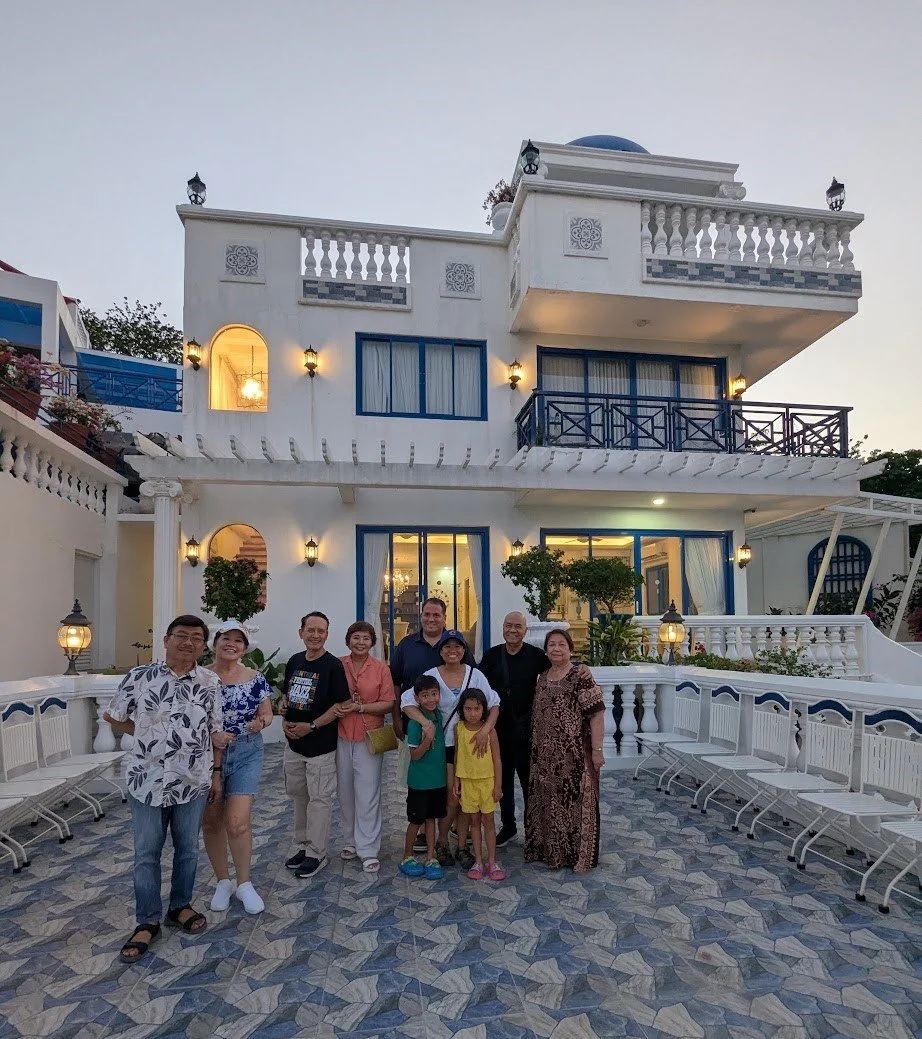
Meraki Hotspring Resort: A Slice of Santorini in the Shadow of Mt. Makiling
When the temperature soars to 41°C and traffic crawls to a halt, with provincial buses crammed full of Holy Week vacationers, any excitement for a supposedly luxurious Santorini-style escape in Pansol, Calamba quickly fades. You can’t help but wonder if you picked the worst possible time for a getaway—right in the middle of April, during the height of the Holy Week rush.
And yet, perhaps this is precisely the right moment to escape. While many locals head home to observe Lent, leaving resorts surprisingly less crowded, only outsiders like us would have the audacity—or luck—to stumble into that rarefied window of quiet.
Had we picked a day or two earlier or later, the trip from Nasugbu, Batangas to our destination in Calamba, Laguna—the Meraki de Arambulo resort—might have been smooth, maybe even pleasant. But timing, as we learned, is everything.
Let this be a small nugget of wisdom to anyone planning a visit: choose your schedule wisely. The journey can be long and trying, especially during peak seasons, but the moment you arrive and step into the tranquil charm of Meraki, the stress begins to lift.
The traffic, the heat, the second-guessing—all of it fades behind the resort’s whitewashed walls and quiet elegance. No matter how rough the road getting there, Meraki makes good on its promise: it’s always worth the trip.
Carved into the slope of the legendary Mt. Makiling, in the small town of Pansol—famous for its therapeutic hot springs—Meraki de Arambulo stands as a loving tribute to Pepe and Peggy Arambulo, forebears of the three siblings who now co-own the place.
Inspired by the Greek town of Santorini, with its signature blue domes and whitewashed walls, local builders—from architects to masons—crafted each room, terrace, hall, stairway, and pool with astonishing attention to detail. The result? A multi-storied sanctuary perched on the mountainside, offering sweeping views of Laguna de Bay, rolling hills and plains, and even a sliver of Manila Bay on a clear day.
Each of the five living spaces at Meraki varies in size and feel. From a romantic suite complete with a four-poster bed and gauzy linens, to bunk-and-rollaway rooms perfect for event organizers, every space is a few steps away from a pool.
The real wonder lies in the pools themselves—naturally heated and ingeniously piped from Mt. Makiling’s own hot springs. Clean, warm, and welcoming even late into the night, the water seems to invite you to stay just a little longer. Kids run safely on non-slip tiles while adults sink into the healing warmth, shedding fatigue with every dip.
Strangely—or perhaps wisely—the resort doesn’t serve Greek cuisine. Instead, the experience is refreshingly personal. As a balikbayan, I was delighted to find my cravings for Filipino comfort food met with near-maternal attentiveness.
Craving puto, sinigang, or sweet ripe mangoes? A housemother is there to shop, prep, and cook just for you, doting over each dish like it was a family gathering. But, if you’d rather eat out, you’re handed a curated list of local restaurants serving both Filipino and international fare. For larger events, guests are free to bring in their own caterers—another thoughtful touch that makes Meraki feel more like a home than a hotel.
The Mountain’s Quiet Blessing
There’s something quietly sacred about Meraki. Maybe it’s the view, maybe it’s the quiet, or maybe it’s the legendary presence of Maria Makiling, said to guard the forests and restore life when nature suffers harm.
You feel her here—not in overt mythology, but in the way the garden seems always blooming, in how the air stays soft and clean, in the sense that something larger is watching over it all. We felt that presence, that peace, during our two-night, three-day stay.
Meraki is more than a picturesque retreat—it is a space carved out of both memory and myth, shaped by family legacy and sustained by local craftsmanship. It offers not just respite, but reverence. Here, amid hot springs and hushed mornings, you come to understand that true luxury isn’t just about comfort or aesthetics—it’s about belonging, however briefly, to a place that remembers why it was made.