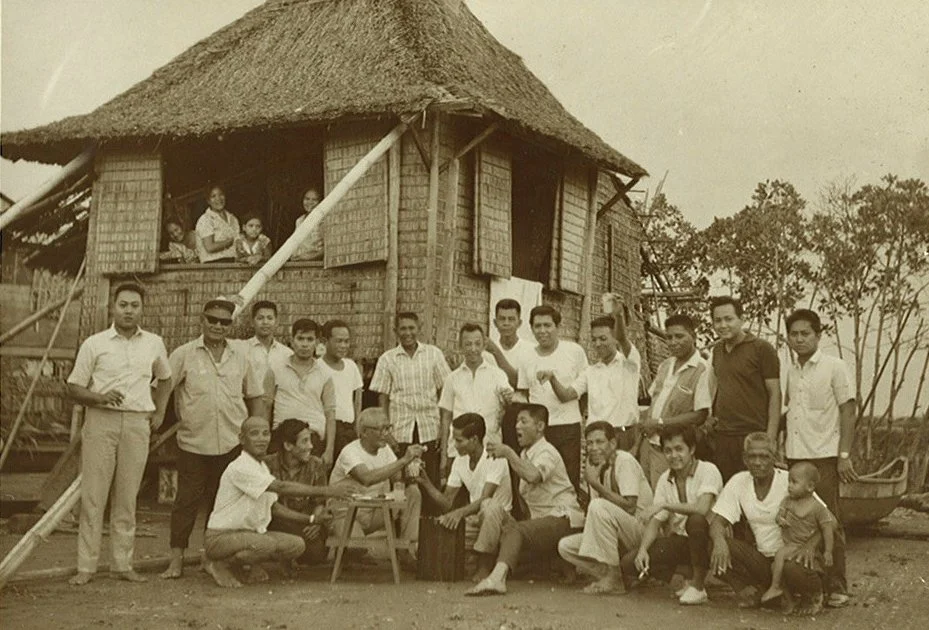
Tonyong Suka in Vertical-Striped Shirt (center, standing)
From the corner bedroom window of our house in the early sixties, just as I was starting high school, I fell into the habit of watching the daily rhythm of our street.
Early mornings brought a slow parade of water buffaloes herded by young boys, plodding along our dirt road. Like clockwork, one or more of the beasts would deposit methane-rich dung directly in front of our house. The steam drifting off those fresh road cakes was visually hypnotic; the stench, nasally assaulting.
That was long before our street was paved—back when the dirt road was crusty and dusty in the dry season, and a knee-deep quagmire in the wet. P. Santos Street in the town of Malibay was known back then as Daang Kalabaw (Carabao Road) for that very reason. Local families, including my future husband's, worked in agriculture, tilling vast tracts of grassland in the surrounding area and turning them into lush rice paddies. Decades later, those fields would be swallowed up by an American airfield, an international airport, and a premier subdivision.
On a rented lot along P. Santos Street, my father built our family's first home—a two-story, four-bedroom house we could finally call our own. In doing so, my father came full circle. As a young man, he had left this very neighborhood to seek his fortune in faraway places. After hopping with his growing family from one rented house to another, he eventually returned to live among his kin. In fact, C. Jose Street, the town’s major thoroughfare running parallel to ours, was named after an ancestor.
At that same early morning hour, a stooped old man would be out watering his asparagus plots on a vacant lot. Wives and daughters tended potted flowering plants and hibiscus hedges along perimeter fences. Ambulant vendors cried out their wares: warm pandesal, fresh carabao milk in repurposed glass Coca-Cola bottles, six-packs of Japanese Yakult probiotic drinks, and taho—that heavenly silken tofu with tapioca pearls drenched in sweet syrup.
But the figure who intrigued me most was a man in his nineties pushing a large wooden cart loaded with heavy casks and massive Dama Juana (demijohn) glass bottles filled with vinegar, or suka. The townspeople called him “Tonyong Suka”—an alias used to distinguish him from the other Tonyos, Tonys, and Antonios in town.
To tell families apart, local communities adopted inherited aliases called bansag, usually based on an ancestor’s trade. Pamilyang Pugo was bestowed upon a family that raised and sold quail chicks and eggs. Extraordinary life events could also define a clan: my husband’s family, for instance, was known as Pamilyang Kastila—not because any Spanish blood flowed through their veins, but because a Spaniard served as godfather at his grandfather’s baptism, a notable occurrence in those days.
Tonyong Suka made his rounds while the morning sun was just beginning its ascent and the air was still cool and dewy. Tall and sporting a tight crew cut, he had broad shoulders and what I could have sworn was a six-pack of abs visible through his thin white T-shirt.
“Could he have been an ex-military man?” I used to wonder. “What was he doing hawking on the street? And why vinegar?”
Where was he making it? In his house? We were nowhere near any nipa palm groves, and I knew most households bought their vinegar from the corner sari-sari store. I later learned that he supplied vinegar to those neighborhood sari-sari stores, to the households of prominent relatives, and to the vendors at the emerging talipapa—a temporary wet market springing up along our street.
Sukang sasa, also known as sukang puti, is vinegar made from the sap of the nipa palm flower stalk. Tonyong Suka bought the cloudy white liquid in its most concentrated form from his hometown of Hagonoy, Bulacan, diluting it with water once he got back to his house on P. Santos Street. He sold it wholesale, and his customers retailed it by the measuring cup, pouring the liquid directly into buyers' brought-from-home containers.
That buff physique of his was likely forged from pushing a heavy wooden cart all day along soft, boggy, or rutted dirt roads full of drying mounds of carabao dung. The crew cut was simply a grooming preference—or perhaps a practical way to keep his head cool under the tropical sun.
Business was brisk. Vinegar was—and remains—an indispensable pillar of the Filipino palate: serving as a dipping sauce condiment, a curing agent for kinilaw, a tenderizing marinade, or the essential souring element in a braise. Throughout my youth, Tonyong Suka’s sukang puti nourished me through my mother’s cooking—flavoring my favorite dishes of kinilaw, paksíw, and adobo.
With the eventual arrival and dominance of industrially produced white vinegar, Tonyong Suka’s traditional business faded away. Yet the town’s appetite for vinegar never waned, and the sprawling talipapa eventually claimed all of P. Santos Street—a bustling market born from the quiet morning streets of my youth.